BMW’s VANOS system explained in simple terms — what it does, how it works, which engines use it and the problems you should look for when buying a used BMW.
If you’ve ever owned or considered buying an older BMW, you’ve probably come across the term VANOS.
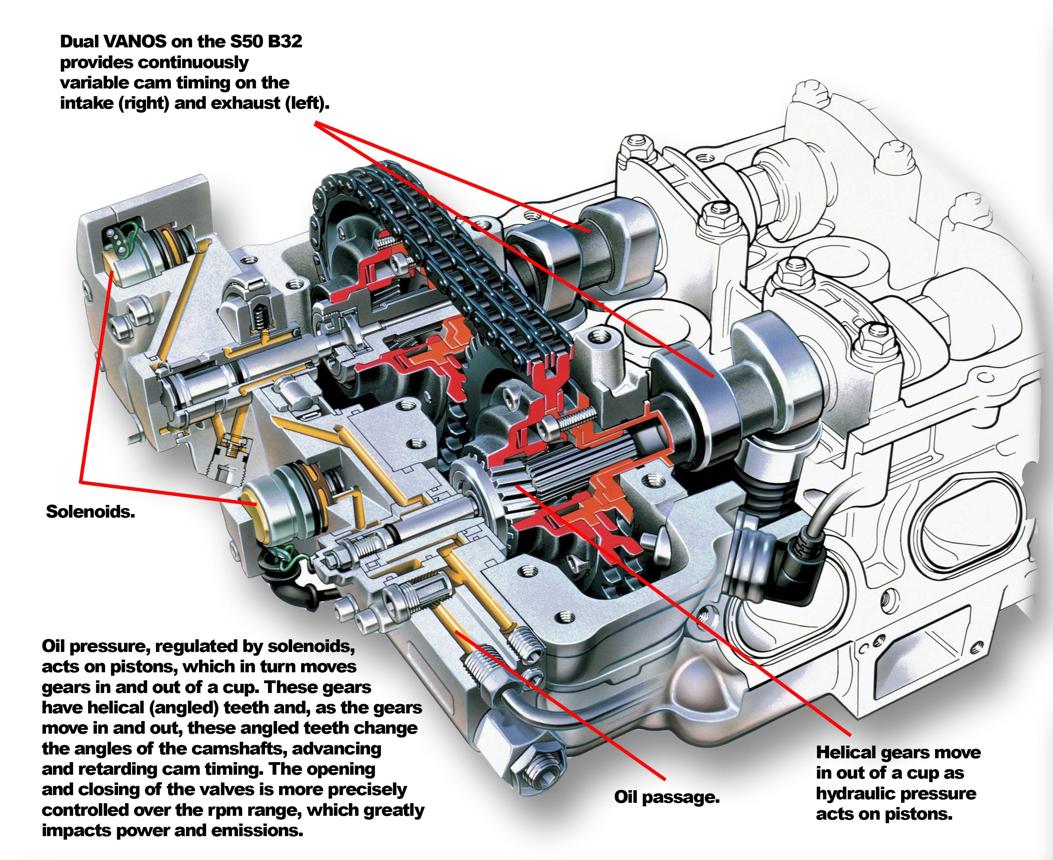
It is BMW’s variable camshaft timing system and has been used on a huge range of BMW petrol engines since the early 1990s.[more info] VANOS allows the engine to alter camshaft timing according to engine speed and load, helping BMW achieve a combination of performance, refinement, economy and emissions that would be difficult with fixed valve timing.
The good news is that VANOS is generally a robust system. However, some older BMW engines have well-known VANOS-related weaknesses, particularly as mileage increases.
So, what exactly is VANOS and should you be worried about it when buying an older BMW?
What does VANOS mean?
VANOS is BMW’s name for its variable camshaft timing system.
The word comes from the German:
VAriable
NOckenwellen
Steuerung
In English, this translates roughly as Variable Camshaft Timing.
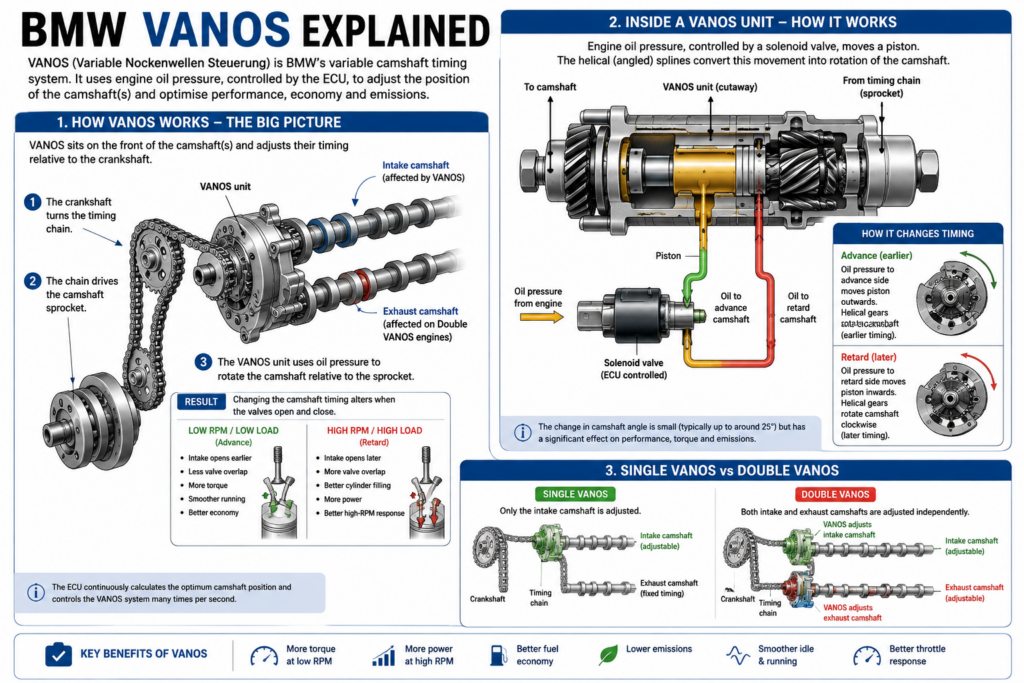
The system changes the position of the camshaft relative to the crankshaft while the engine is running.
This allows BMW to optimise valve timing for different engine speeds and operating conditions.
Why does an engine need variable valve timing?
A conventional engine with fixed camshaft timing has to compromise.
At low engine speeds, one set of valve timing characteristics may be desirable. At high engine speeds, different timing can produce better cylinder filling and therefore more power.
VANOS allows the engine to change the timing as conditions change.
At low RPM, the system can optimise timing for:
- Better low-speed torque
- Smoother running
- Improved fuel economy
- Better emissions
At higher RPM, the timing can be changed to improve:
- Airflow
- Cylinder filling
- High-RPM power
- Throttle response
The result is an engine that feels stronger across a much wider rev range.
How does VANOS work?
The basic principle is relatively straightforward.
The engine’s electronic control unit monitors conditions such as:
- Engine speed
- Engine load
- Throttle position
- Coolant temperature
- Camshaft position
- Crankshaft position
It then controls oil-pressure-operated VANOS mechanisms to alter the position of the camshaft.
The change is relatively small, but it can have a significant effect on the engine’s characteristics.
Think of it as continually adjusting the engine’s valve timing to suit what you’re asking the engine to do.
Single VANOS
The first generation of BMW VANOS systems generally operated on one camshaft, usually the intake camshaft.
BMW introduced VANOS on production engines in the early 1990s.
One well-known example is the M50TU, the updated version of BMW’s M50 straight-six.
Single VANOS was subsequently used on engines including various versions of the:
- M50
- M52
- M62
The exact operation differs between engines, but the principle is the same: adjust camshaft timing to improve the engine’s flexibility.
What are the advantages of single VANOS?
The system can provide:
- More low-speed torque
- Better throttle response
- Improved fuel economy
- Reduced emissions
- Smoother operation
It was an important development in BMW’s straight-six and V8 engines.
Double VANOS
BMW subsequently developed Double VANOS, which controls both the intake and exhaust camshafts.
This provides considerably more control over valve timing.
Double VANOS appeared on engines including the:
- M52TU
- M54
- M56
- M62TU
- S54
- N52
- N62
The exact system varies considerably between these engines, but controlling both camshafts gives BMW much greater flexibility.
Why is Double VANOS better?
With both camshafts adjustable, BMW can control valve overlap much more precisely.
This can improve:
- Low-speed torque
- Mid-range performance
- High-speed power
- Fuel economy
- Emissions
- Idle quality
It also helps give BMW engines their characteristic combination of smoothness and willingness to rev.
VANOS and Valvetronic are not the same thing
This is an important distinction.
VANOS changes valve timing.
Valvetronic changes valve lift.
Later BMW engines often use both systems.
Valvetronic can vary how far the intake valves open, effectively controlling engine airflow without relying solely on a conventional throttle butterfly.
Combined with VANOS, this gives BMW extremely sophisticated control over the engine.
Some engines using these technologies include various versions of the N42, N46, N52 and N62.
Common VANOS problems
VANOS itself isn’t necessarily unreliable, but age and mileage can create problems.
The most common issues depend heavily on the particular BMW engine.
1. Worn VANOS seals
This is particularly associated with some older BMW six-cylinder engines, including the M52TU and M54.
The seals inside the VANOS mechanism can deteriorate with age.
Possible symptoms include:
- Reduced low-RPM torque
- Flat spots
- Hesitation
- Poor throttle response
- Rough running
- Increased fuel consumption
The engine may still run perfectly well, which means the problem can easily go unnoticed.
Fortunately, replacement seal kits are available and the repair is considerably cheaper than replacing the complete VANOS unit.
2. VANOS solenoid problems
The VANOS system relies on electrically controlled solenoids to regulate oil flow.
A dirty, sticking or failed solenoid can prevent the system from operating correctly.
Symptoms can include:
- Poor acceleration
- Uneven running
- Engine warning light
- Poor fuel economy
- VANOS-related fault codes
Sometimes cleaning the solenoid is sufficient. In other cases, replacement is required.
3. VANOS rattling
Some BMW engines can develop a distinctive rattling noise from the VANOS mechanism.
A light rattle doesn’t necessarily mean imminent engine failure, but it should be investigated.
On an older BMW, a rattling noise from the front of the engine should never simply be dismissed as “they all do that”.
4. Dirty engine oil
VANOS depends on engine oil pressure and clean oil.
Poor servicing can therefore cause problems.
Oil sludge or contaminated oil can affect the small oil passages and solenoids used by the system.
This is one reason why a good service history is particularly valuable when buying an older BMW.
Which BMW engines have VANOS?
The following table gives a simplified overview.
| BMW engine | VANOS type | General reputation |
|---|---|---|
| M50TU | Single VANOS | Very good |
| M52 | Single VANOS | Very good |
| M52TU | Double VANOS | Good |
| M54 | Double VANOS | Good |
| M56 | Double VANOS | Good |
| M62TU | Single VANOS | Good |
| S54 | Double VANOS | Excellent performance, more complex |
| N52 | Double VANOS + Valvetronic | Very good |
| N62 | Double VANOS + Valvetronic | More complex |
This is a simplified guide because BMW produced numerous variations of these engines and VANOS systems.
Is VANOS reliable?
Generally, yes.
The important thing to remember is that VANOS is now fitted to engines that can be 20 or 30 years old.
A system that was perfectly reliable when new may need attention simply because seals, solenoids and other components have aged.
That doesn’t necessarily make the engine a bad choice.
In fact, many BMW engines fitted with VANOS have proved capable of very high mileages when properly maintained.
How to check VANOS when buying a used BMW
If you’re looking at an older BMW, don’t automatically reject it because the engine has VANOS.
Instead, look for evidence of proper maintenance.
Check the engine from cold
A cold start can reveal problems that may disappear once the engine warms up.
Listen for:
- Excessive rattling
- Ticking
- Rough running
- Hesitation
- Unstable idle
Test the engine through the rev range
A healthy BMW engine should pull smoothly.
Pay particular attention to:
- Low-RPM response
- Mid-range acceleration
- High-RPM performance
- Throttle response
A noticeable flat spot may indicate a VANOS or related engine-management problem.
Check for fault codes
A diagnostic scan is worthwhile when buying an older BMW.
VANOS-related faults can sometimes be stored even when the engine warning light isn’t illuminated.
Check the service history
Regular oil changes are particularly important.
I’d much rather buy an older BMW with 120,000 miles and an excellent service history than one with 70,000 miles and questionable maintenance.
Does VANOS make an older BMW a bad buy?
No.
This is particularly important when looking at desirable older BMWs.
A VANOS system that needs refurbishment isn’t necessarily a reason to walk away from the car.
Instead, establish exactly what is wrong and get the repair cost factored into the purchase price.
The bigger concern is buying a car where multiple age-related problems have been ignored.
VANOS on BMW E38 engines
For buyers interested in the BMW E38, the situation is particularly interesting.
The 728i uses the six-cylinder M52 engine family, while the V8 models use members of BMW’s M62 family.
The later M62TU V8 received VANOS.
This means that when comparing E38 models, it is important to identify the exact engine and production year rather than simply assuming that all 7 Series engines use the same VANOS arrangement.
For an E38 intended as a regular-use classic, the condition of the entire car is ultimately more important than whether it has VANOS.
VANOS: the BetterBangers verdict
VANOS was an important development in BMW engine technology and helped BMW produce engines that were simultaneously powerful, smooth and relatively economical.
The system itself shouldn’t frighten buyers of older BMWs.
The key is understanding the particular engine you’re buying and knowing its known weaknesses.
For many older BMWs, a VANOS problem is a repairable maintenance issue rather than a reason to reject the car.
If you’re considering buying an older BMW, I’d put the following much higher on the checklist:
Service history + engine condition + gearbox condition + cooling system + rust + suspension + electrical condition.
A well-maintained BMW with a functioning VANOS system can still provide exactly what BMW intended when the technology was introduced: a smooth, flexible engine that is equally happy cruising gently or being worked hard.
Quick summary
VANOS = variable camshaft timing.
Single VANOS = one camshaft is adjusted.
Double VANOS = both camshafts are adjusted.
Valvetronic = variable valve lift, which is different from VANOS.
Common problems = seals, solenoids, oil contamination and mechanical wear.
Verdict = VANOS is generally reliable and shouldn’t put you off buying an older BMW.
Suggested SEO information
SEO title:
BMW VANOS Explained: How It Works, Problems & Reliability
Meta description:
BMW VANOS explained in simple terms. Discover how VANOS works, Single vs Double VANOS, common problems, reliability and what to check when buying an older BMW.
Primary keyword:
BMW VANOS
Secondary keywords:
BMW VANOS problems
BMW Double VANOS
BMW Single VANOS
BMW VANOS reliability
BMW VANOS explained
BMW VANOS seals
BMW Valvetronic vs VANOS
Suggested URL slug:bmw-vanos-explained
Suggested category:
BMW
Suggested tags:
BMW, VANOS, BMW engines, BMW maintenance, BMW reliability, E38, M52, M54, M62