
The classic Mercedes that really can still be used every day
There are few cars that have acquired quite the reputation of the Mercedes-Benz W124.
Built from 1984 onwards, the W124 was engineered at a time when Mercedes-Benz still believed that a car should be capable of doing hundreds of thousands of miles without falling apart. It was beautifully built, understated, comfortable and technically sophisticated without being unnecessarily complicated.
Today, the W124 makes a very tempting classic Mercedes. Prices have risen considerably for the best cars, but good examples can still be bought for sensible money.
The trick is finding the right car.
And that means looking beyond the three-pointed star on the bonnet.
W124 at a glance
| Model | Production | Engine | Better known for |
| 200 / E200 | 1985–95 | 2.0 4-cylinder | Simplicity |
| 230E | 1985–92 | 2.3 4-cylinder | Excellent all-rounder |
| 260E | 1985–92 | 2.6 straight-six | Smoothness |
| 300E | 1985–93 | 3.0 straight-six | The classic choice |
| 300E-24 | 1989–92 | 3.0 24v | Performance |
| E280 | 1992–95 | 2.8 straight-six | Later refinement |
| E320 | 1992–95 | 3.2 straight-six | Performance and refinement |
| 400E / E420 | 1991–95 | 4.2 V8 | V8 performance |
| 500E / E500 | 1990–95 | 5.0 V8 | Modern classic icon |
| 200D | 1985–93 | 2.0 diesel | Economy and longevity |
| 250D | 1985–93 | 2.5 diesel | Durability |
| 300D | 1985–93 | 3.0 diesel | Long-distance workhorse |
Mercedes-Benz produced more than 2.2 million W124 saloons, with production of the wider 124 family continuing into 1997 for some body styles. (Mercedes-Benz Media)
Which W124 should you buy?
This is where things get interesting.
There isn’t necessarily one “best” W124. The best car for you depends on whether you want an economical daily driver, a comfortable classic, a fast executive car or something that is likely to become increasingly collectible.
For most buyers, however, we’d concentrate on five cars:
230E – the sensible choice
The 230E is probably the W124 that makes the most sense if you want relatively straightforward mechanicals, respectable performance and reasonable running costs.
The 2.3-litre four-cylinder M102 engine is not exciting, but it suits the character of the car perfectly.
It is also considerably more economical than the larger six-cylinder cars.
BetterBangers verdict: 8/10
260E – the underrated choice
The 260E is an interesting alternative.
Its 2.6-litre M103 straight-six gives the W124 a considerably more relaxed character than the four-cylinder cars.
It isn’t particularly fast, but it is smooth, quiet and effortless.
For a classic Mercedes that you intend to use regularly, we’d take a good 260E over a mediocre 300E every time.
BetterBangers verdict: 9/10
300E – arguably the sweet spot
If you want the traditional W124 experience, the 300E is difficult to beat.
The 3.0-litre M103 straight-six is smooth, strong and has enough performance to make the W124 feel like a proper executive car.
It is also one of the engines that helped establish the W124’s reputation for longevity.
The downside is fuel consumption. A 300E is not the car to buy if economy is your overriding concern.
BetterBangers verdict: 9.5/10
E280 and E320 – the modern choice
The later cars are particularly attractive if you want to use your W124 regularly.
The E280 and E320 use the later M104 four-valve-per-cylinder straight-six engines. The E320 produces considerably more power than the earlier six-cylinder cars while retaining the smoothness you’d expect from a Mercedes straight-six.
They are faster and more refined than the earlier cars.
However, they also bring additional complexity and some age-related issues of their own.
BetterBangers verdict: 9/10
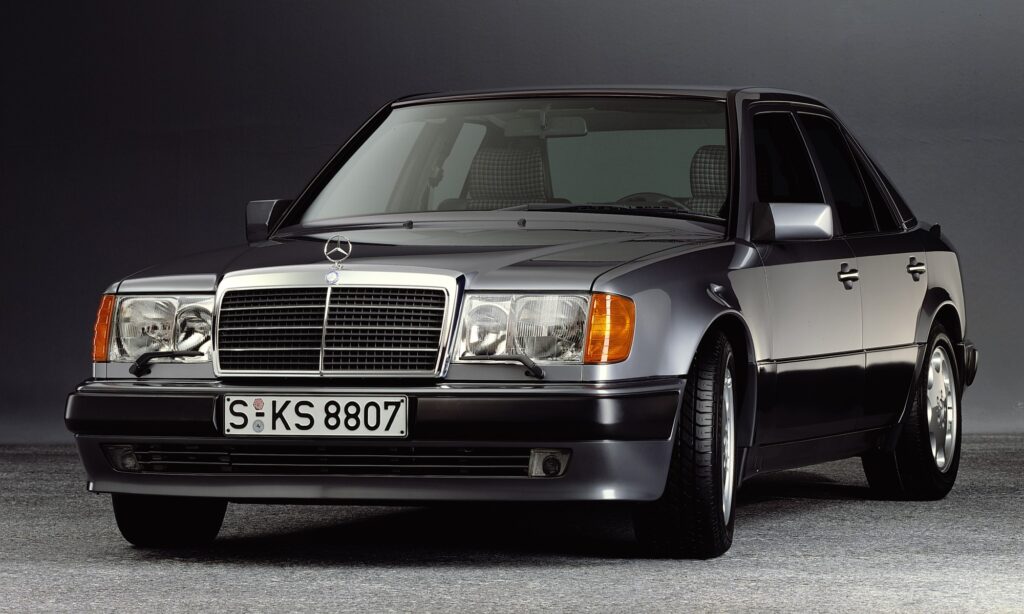
500E/E500 – the collector’s choice [more…]
Then there is the 500E.
This is a completely different proposition.
With its 5.0-litre V8 and Porsche involvement in its development and production, the 500E was effectively a Mercedes-Benz super-saloon disguised as an ordinary W124.
The 500E made its debut in 1990 and produced around 326bhp.
Today it is highly collectible and consequently much more expensive than an ordinary W124.
For most BetterBangers readers, we’d suggest buying a superb 300E rather than a tired 500E.
BetterBangers verdict: 10/10 – if you can afford one
W124 body styles
The W124 wasn’t just a saloon.
Mercedes produced four principal versions:
- Saloon – W124
- Estate – S124
- Coupé – C124
- Cabriolet – A124
The estate arrived in 1985, the coupé followed in 1987 and the cabriolet arrived in the early 1990s. (Hagerty UK)
The saloon
The saloon is the easiest place to start.
There are plenty of them around, parts availability is good and they generally cost less than equivalent coupés and convertibles.
The estate
The S124 estate is probably our favourite.
It combines the classic W124 driving experience with enormous practicality.
Good estates are increasingly sought after, however, and they can suffer from rust in areas that are less obvious than on the saloon.
The coupé
The C124 has always looked special.
With its pillarless doors and frameless windows, it is arguably the prettiest W124.
However, the additional bodywork and window mechanisms mean there is more to check.
The cabriolet
The A124 is now a genuine modern classic.
It is also the most expensive way into W124 ownership and potentially the most expensive to repair.
Buy on condition rather than specification.
W124 rust – the biggest problem
Forget the mileage.
Forget whether it has leather.
Forget whether it has a sunroof.
Rust is what should determine whether you buy a W124.
A mechanically tired W124 can be repaired.
A seriously rotten W124 can consume many thousands of pounds.
The important thing is that rust isn’t always obvious.
Check the front wings
Look around the wheelarches and underneath the front wings.
Don’t simply inspect the painted surface. Look inside the wheelarch for corrosion around the inner wing.
Check the jacking points
These are particularly important.
Get underneath the car and inspect every jacking point carefully.
If possible, use a torch and physically inspect the metal rather than relying on a quick visual inspection.
Check the doors
Look along the bottom edges of all four doors.
Open them and inspect the seams and drain holes.
Check the rear arches
The rear wheelarches are another common corrosion area.
Look carefully at both the outer and inner arches.
Check underneath
This is where a proper inspection earns its money.
Look at:
- Floor pans
- Sills
- Subframes
- Brake lines
- Fuel lines
- Suspension mounting points
- Rear axle area
- Exhaust mounting points
Heavy underseal isn’t necessarily good news.
It can conceal previous repairs – or corrosion.
Rust is widely regarded as the W124’s biggest enemy, with wheelarches, jacking points, inner wings, rear subframe areas and floor sections all deserving close inspection. (Classics World)
Which engine is best?
This is where W124 ownership gets interesting.
M102 four-cylinder
Found in cars such as the 200 and 230E.
The M102 is relatively simple and well understood.
It doesn’t provide the effortless performance of the six-cylinder cars, but it can make a very good daily driver.
Our choice: 230E
M103 straight-six
Found primarily in the 260E and 300E.
This is one of the engines that gives the W124 its character.
The 2.6 is smooth.
The 3.0 is smoother still and provides noticeably better performance.
For a BetterBangers W124, the M103 3.0 would be very high on our shopping list.
M104 straight-six
The later E280 and E320 received four-valve-per-cylinder M104 engines.
They are more powerful and sophisticated than the earlier engines.
They can also suffer from age-related electrical and sealing problems, so condition and history are important.
A later E320 with a good history is nevertheless one of the best W124s for regular use.
The dreaded biodegradable wiring loom
This is one of the most important things to understand when buying a later Mercedes of this era.
Mercedes-Benz introduced biodegradable wiring insulation during the early 1990s. Unfortunately, the insulation can deteriorate with age.
The problem is particularly relevant to later W124s.
If the insulation has become brittle and is breaking apart, electrical problems can follow.
A replacement loom can be expensive.
Check whether the wiring harness has already been replaced.
If it has, find out when and obtain evidence if possible.
This isn’t a reason to automatically reject a later W124, but it is a reason to investigate carefully. The wiring issue is well documented in W124 buyer guides.
Suspension and steering
The W124’s multi-link rear suspension was technically sophisticated when the car was new.
It also means that a 30-year-old W124 can have quite a few worn bushes, mounts and joints.
On the test drive, listen for:
- Knocks over bumps
- Clunks from the rear
- Wandering steering
- Excessive body movement
- Uneven tyre wear
- Vibration
Don’t automatically blame the shock absorbers.
A tired W124 can need several suspension components replacing before it returns to the way it drove when new.
Automatic gearbox
Most W124s you’ll encounter have an automatic gearbox.
Don’t be frightened of one.
A well-maintained Mercedes automatic can be extremely durable.
But don’t believe the old myth that the gearbox is “sealed for life”.
Check:
- Does it engage Drive and Reverse promptly?
- Are the changes smooth?
- Does it flare between gears?
- Does it kick down correctly?
- Is there evidence of fluid leakage?
- Is there evidence of servicing?
A gearbox that changes smoothly when cold and hot is what you want.
Interior
The W124 interior is one of its great strengths.
The driving position remains excellent and the controls have a satisfying mechanical feel.
But age takes its toll.
Check:
- Dashboard cracks
- Seat bolsters
- Headlining
- Door cards
- Electric windows
- Central locking
- Electric seats
- Air conditioning
- Heater controls
- Instrument illumination
- Sunroof
- Cruise control
A car with a perfect engine but a neglected interior is unlikely to be a bargain.
Interior parts can be surprisingly expensive.
Electrical equipment
Try absolutely everything.
Don’t assume that because the car starts and drives everything else works.
Test:
- Every electric window
- Central locking
- Mirrors
- Sunroof
- Headlamps
- Indicators
- Wipers
- Heater blower
- Air conditioning
- Instrument cluster
- Warning lights
- Cruise control
- Seat adjustment
- Radio
Electrical faults can be particularly irritating on an old Mercedes because there may be several seemingly unrelated causes.
What about mileage?
This is one of those occasions when mileage really isn’t everything.
A 180,000-mile W124 with a thick history folder, regular servicing and a rust-free body can be a much better purchase than a 90,000-mile car that has spent 20 years being neglected.
Mercedes built these cars to cover serious mileage.
A well-maintained W124 with 150,000–200,000 miles shouldn’t automatically scare you.
In fact, we’d rather see:
180,000 miles + 25 years of maintenance
than:
90,000 miles + 15 years of neglect.
Service history – what you really want
Look for evidence rather than promises.
Ideally, the car should come with:
- Original service book
- Old MOT certificates
- Invoices
- Mercedes or specialist servicing records
- Evidence of suspension work
- Evidence of cooling-system maintenance
- Gearbox servicing
- Evidence of rust repairs
- Wiring-harness replacement where applicable
- Multiple previous MOT records
A thick folder of invoices is worth far more to us than a seller saying:
“It’s a Mercedes mate. It’ll go forever.”
What should you pay?
This is a difficult question because W124 prices vary enormously.
A tired project can be relatively cheap.
A genuinely exceptional, low-mileage, original example can command serious money.
And the 500E/E500 lives in an entirely different market.
Don’t buy according to the cheapest advertised car.
Instead, establish what the car will cost you after you’ve made it right.
A £5,000 W124 needing £8,000 of work isn’t cheap.
A £10,000 car needing almost nothing may be the bargain.
The W124 test drive
Don’t rush it.
Start the car from cold.
Listen carefully.
The engine should start readily and settle into a reasonably smooth idle.
Watch the temperature gauge.
Then drive the car through:
Town driving
Check:
- Automatic gearbox operation
- Steering
- Brakes
- Cooling
- Ride quality
Faster roads
Check:
- Straight-line stability
- Steering feel
- Gear changes
- Engine performance
- Vibration
Rough roads
Listen carefully for suspension knocks.
A good W124 should feel remarkably composed.
That is one of the reasons these cars still feel special today.
Five W124 buying mistakes
1. Buying the cheapest one
Don’t.
Buy the best body you can afford.
2. Believing the mileage
Mileage is only one part of the story.
Condition and history matter more.
3. Ignoring rust
This is probably the biggest mistake you can make.
4. Buying on specification
Leather, sunroof, air conditioning and electric seats are lovely.
But none of them will make a rotten W124 a good car.
5. Not getting underneath
A W124 can look magnificent from ten feet away.
Get it on a ramp.
Our favourite W124s
If we were spending our own money, we’d shortlist these:
🥇 Mercedes 300E
The classic choice.
Smooth straight-six, excellent build quality and plenty of character.
🥈 Mercedes E320
The best regular-use W124.
More modern engine, more performance and excellent refinement.
🥉 Mercedes 260E
The sensible enthusiast choice.
Smooth, relatively simple and generally less expensive than the bigger-engined cars.
🏆 Mercedes 500E/E500
The ultimate W124.
But you’re buying into a completely different price bracket.
⭐ Mercedes 230E
The bargain choice.
If you want the W124 experience without the fuel consumption of a six-cylinder car, it’s difficult to ignore.
Should you buy a Mercedes W124?
Absolutely – but condition is everything.
The W124 has one of the strongest reputations of any Mercedes-Benz, and that reputation isn’t entirely based on nostalgia.
It was engineered properly.
The suspension was sophisticated.
The engines were generally extremely durable.
The interior was built to withstand years of use.
And the styling has aged beautifully.
Mercedes-Benz itself describes the W124 as an important step forward in lightweight construction, aerodynamics and engineering, while the company produced more than 2.7 million examples across the complete 124 family. (Mercedes-Benz)
But don’t confuse well engineered with indestructible.
Every W124 is now an old car.
The newest examples are more than 30 years old and even the youngest cabriolets are approaching three decades.
Rubber deteriorates.
Bushes wear out.
Electrical insulation ages.
Seals leak.
And rust never sleeps.
The good news is that there are still plenty of specialists who understand these cars, parts availability remains relatively good and Mercedes-Benz Classic continues to support the model. (Mercedes-Benz Media)
The BetterBangers verdict
Buy the body first.
Then buy the history.
Then choose the engine.
If you can find a structurally sound, well-maintained 230E, 260E, 300E, E280 or E320, you could end up with one of the best classic Mercedes-Benz cars you can actually use every day.
And that’s the real appeal of the W124.
It’s not just a classic.
It’s a classic you can still drive.
BetterBangers W124 buying checklist
Before handing over your money, check:
- Rust-free body and structural areas
- Front wings and inner wings
- Rear arches
- Sills and jacking points
- Floors
- Rear subframe mounting areas
- Brake and fuel lines
- Engine oil leaks
- Cooling system
- Automatic gearbox operation
- Suspension bushes and joints
- Steering
- Brakes
- Exhaust
- Air conditioning
- Electric windows
- Central locking
- Sunroof
- Interior condition
- Wiring harness on applicable later cars
- Service history
- MOT history
- Previous restoration work
- Evidence of regular maintenance
Most importantly: get the car inspected on a ramp before buying it.
A £100–£200 inspection could save you thousands.
BetterBangers rating
Build quality: ⭐⭐⭐⭐⭐
Engine durability: ⭐⭐⭐⭐⭐
Comfort: ⭐⭐⭐⭐⭐
Driving experience: ⭐⭐⭐⭐½
Parts availability: ⭐⭐⭐⭐
Rust resistance: ⭐⭐½
Running costs: ⭐⭐⭐
Classic appeal: ⭐⭐⭐⭐⭐
Overall:
9/10
BetterBangers says: One of the best-engineered old Mercedes you can buy – provided you find one that hasn’t been eaten by rust.
Editor’s note: Model specifications and equipment varied by market and production year. Always check the individual car’s VIN, build data and service history rather than relying solely on the badge or registration year.